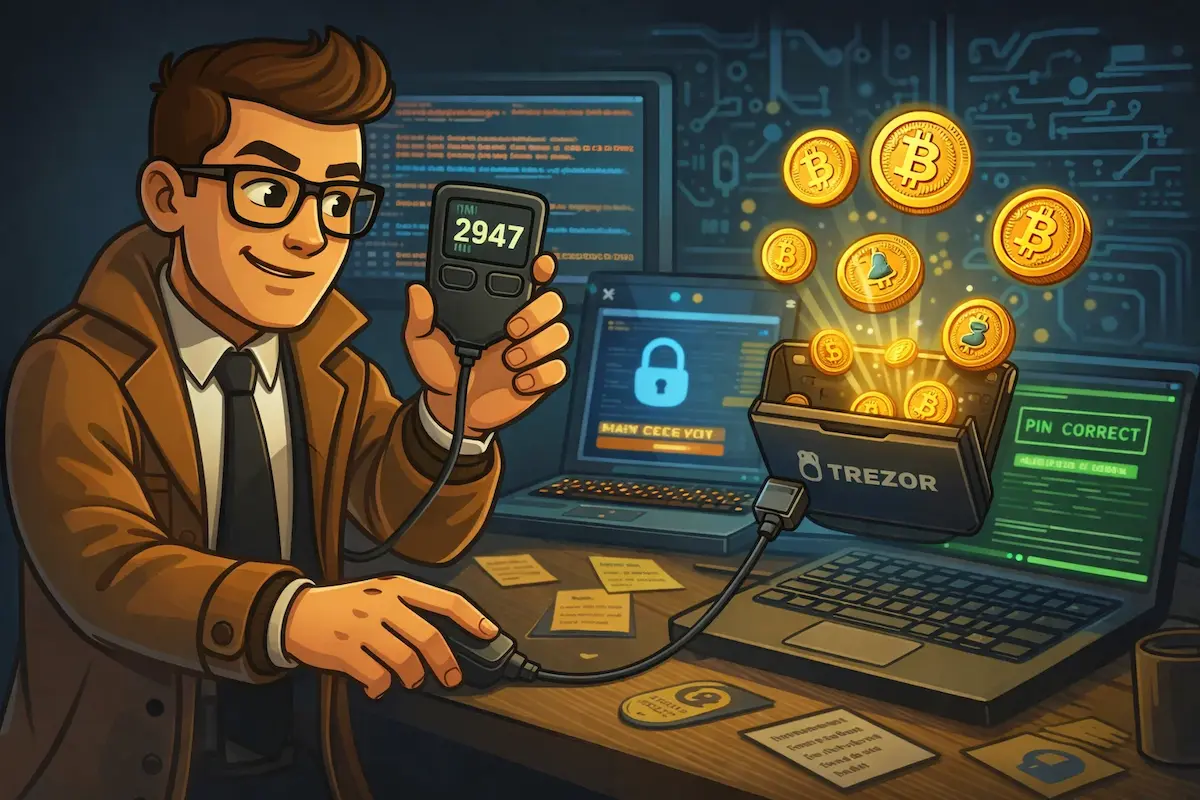
Lost your Trezor? Dropped it, drowned it, or simply can’t find it anywhere? Take a breath, because in almost every case your crypto is completely safe. Your coins were never stored on the Trezor itself. They live on the blockchain, and the device was only ever the key that signs for them. As long as you still have your recovery seed, you can recover your Trezor wallet without the device at all.
This guide explains exactly how to get back into your funds after a lost, broken, or stolen Trezor, what your options are, and how to do it safely.
First, the One Thing That Actually Matters
Whether your Trezor is lost, snapped in half, water-damaged, or stolen, the recovery process is the same, and it hinges on a single item: your recovery seed. This is the 12, 20, or 24-word backup you wrote down when you first set up the device.
With that seed (and your passphrase, if you set one), you hold everything needed to rebuild the wallet somewhere else. Without it, and without the device, there is unfortunately no way back in, not through Trezor and not through any service. So before anything else, find your seed backup and confirm it’s complete and readable.
If you have the seed, read on. If you’ve lost the seed as well, our guide on a lost or invalid Trezor seed phrase explains what’s still possible when part of it survives.
Your Options to Recover a Trezor Wallet Without the Device
Because your seed follows the open BIP39 standard, you’re not locked into one piece of hardware. You have three realistic paths, depending on how much you’re recovering and how quickly you need access.
Option 1: Restore onto a new Trezor. If you plan to keep using a hardware wallet, and for larger balances this is the safest choice, simply buy a new Trezor and restore your seed onto it. Your addresses and balances reappear exactly as they were.
Option 2: Restore onto another hardware wallet. Any hardware wallet that supports BIP39 seeds can import your recovery phrase. Your funds aren’t tied to the Trezor brand, they’re tied to the seed.
Option 3: Restore into a software wallet. If you need access right now and don’t have a device on hand, a BIP39-compatible software wallet can import your seed. This is the true “without a device” route. It’s convenient, but it puts your seed on an internet-connected computer, so treat it as a way to move funds quickly to safety rather than a long-term home.
One important note: Trezor Suite itself always needs a Trezor device connected, so “recovering without the device” means using either a new device or third-party software, not Suite on its own.
How to Restore Your Trezor Seed onto a New Device
This is the cleanest option and the one we recommend for anything more than pocket change.
- Buy a new Trezor from the official trezor.io shop or an authorised reseller only.
- Set it up via trezor.io/start and choose “Recover wallet” instead of creating a new one.
- Enter your recovery seed in the exact order you wrote it down.
- Set a new PIN.
- If you used a passphrase, enable it and enter it to reveal your hidden wallet.
- Enable any coins or accounts that don’t appear automatically.
That’s it. The new device regenerates the same keys from your seed, and your balance is right there. For the full walkthrough and the errors that sometimes come up, see our Trezor wallet recovery guide.
How to Recover Into a Software Wallet (No Hardware Needed)
If you have no device at all and need access immediately, you can import your seed into a BIP39-compatible software wallet. Do this carefully.
- Use a clean, trusted computer, ideally one that’s offline (air-gapped) while you enter the seed, then reconnect only when you’re ready to move funds.
- Choose a reputable BIP39 wallet for the coin you’re recovering. For Bitcoin, Electrum is a common choice with automatic path detection. For Ethereum and tokens, a standard BIP39 wallet works.
- Select the import or “restore from seed” option and enter your words in order.
- If your balance doesn’t show up, the cause is almost always the derivation path. Try the standard paths for your coin, or use a wallet with auto-scan.
As a reference, the common Bitcoin derivation paths are m/44’/0’/0’/0/0 (Legacy), m/49’/0’/0’/0/0 (SegWit), and m/84’/0’/0’/0/0 (Native SegWit). Ethereum uses m/44’/60’/0’/0/0.
Because your seed has now touched an online machine, the safest next step is to move your funds into a fresh wallet with a brand-new seed once you’ve regained access, especially if there’s any doubt about that computer’s security.
Lost, Broken, or Stolen: Does It Change Anything?
The recovery itself is identical in all three cases, but the urgency differs.
A broken Trezor is the simplest situation. The hardware is irrelevant once it’s dead. Restore your seed onto a new device or software wallet and carry on. Our article on what happens if your hardware wallet breaks or gets lost covers this in more detail.
A lost Trezor is much the same, with one caveat: someone else may eventually find it. Your PIN protects the device, and it wipes itself after too many wrong guesses, so a finder is very unlikely to get in. Still, the moment you’ve restored your wallet elsewhere, consider moving your funds to a new wallet with a new seed for peace of mind.
A stolen Trezor is the one case to treat as time-sensitive. The PIN and the automatic wipe are strong protection, so a thief almost certainly can’t access your funds. But if you suspect your seed backup may also have been seen or copied, don’t wait. Restore your wallet and move everything to a fresh seed immediately.
Keep Your Recovery Safe: A Few Ground Rules
While recovering a lost Trezor wallet, the same security rules always apply:
- Only ever enter your seed on your own device or a wallet you fully trust, never on a website, pop-up, or in response to an email.
- Buy replacement hardware only from official channels, never a marketplace or second-hand.
- Treat a seed you’ve typed into any online software as potentially exposed, and migrate to a new seed afterwards.
- Be wary of anyone promising to “recover” a wallet for you who asks for your full seed upfront. That’s how scammers operate.
If you’ve lost the device and you’re stuck on a missing seed word, a forgotten passphrase, or you simply want an expert to confirm your options before you touch anything, you can get an honest assessment through our Trezor recovery service.
Recover Trezor Wallet Without Device: FAQ
Can I recover my Trezor wallet without the device?
Yes, as long as you have your recovery seed. Your funds live on the blockchain, so you can restore the same wallet onto a new Trezor, another BIP39 hardware wallet, or a compatible software wallet using your seed.
I lost my Trezor but I have my seed. Are my funds safe?
Yes. A lost Trezor doesn’t put your funds at risk while it’s protected by your PIN, and it wipes after repeated wrong attempts. Restore your wallet elsewhere with your seed, and for extra safety move the funds to a new seed.
Can I recover a Trezor wallet with no device and no seed?
No. Without either the device (and its PIN) or the recovery seed, there is no way to restore the wallet, for you, for Trezor, or for any recovery service. The seed is the only backup.
Is it safe to restore my Trezor seed into a software wallet?
It works, but it exposes your seed to an internet-connected computer. Use a clean, ideally offline machine, move your funds promptly, and then migrate to a new seed on a fresh hardware wallet for long-term storage.
My balance is zero after restoring without the device. What went wrong?
Usually one of two things: a derivation-path mismatch in the software wallet, which you fix by selecting the correct path or using auto-scan, or a missing passphrase, which means your funds are in a hidden wallet that only the passphrase can open.