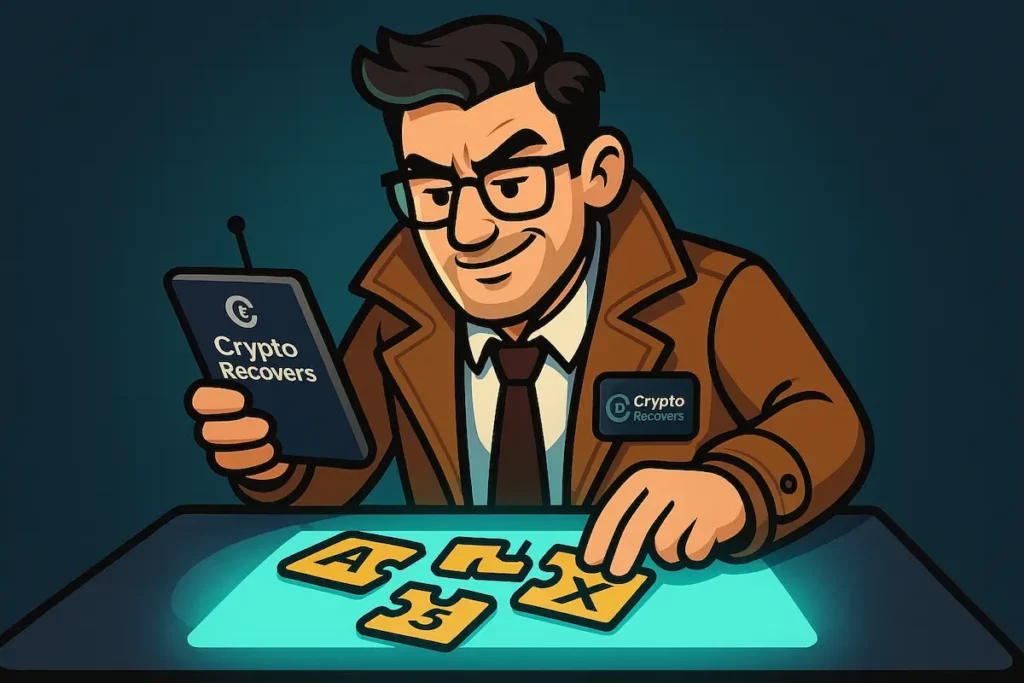

There’s a gap in your recovery phrase. The paper tore, the ink faded, or you only ever wrote down eleven of the twelve words. Nothing about the gap changes what’s recorded on the blockchain: the coins stay put while you rebuild the way in. How realistic that rebuild is comes down to arithmetic, and the numbers are worth understanding before you try anything.
Why a gap can be filled at all
Every word in your phrase comes from a fixed list of 2,048 possibilities. That’s the entire reason a missing word in a seed phrase can be found: it isn’t an open-ended guess, it’s one of 2,048 known candidates per empty position. The phrase also carries a self-check woven into the words (how it works, and why wallets reject broken phrases, is explained in our invalid-phrase guide). Its job here is quieter: it silently disqualifies most candidates before anything gets tested. For a 12-word phrase with one blank, only about 128 of the 2,048 candidates even pass the self-check. For a 24-word phrase, about 8 do.
The last piece is one of your old receiving addresses. Candidates that pass the self-check each open a different wallet; the address is what identifies which of those wallets is yours. Search plus filter plus confirmation: that’s the whole method.
Before you test anything
Write down what you still have, before your memory of it blurs: the surviving words in their positions, the phrase length, which positions are blank, and where the phrase came from. If the backup is torn or faded, photograph it before handling it further. A partly legible word narrows a position from 2,048 candidates to a handful, and that fragment is worth protecting. Then find one old receiving address, from a transaction record, an exchange withdrawal, or an old wallet screenshot. Without it, no search can confirm its answer.
If the phrase came from a Ledger or Trezor device, the brand-specific situations are covered separately: our Ledger seed guide and Trezor seed guide.
What the search costs, by number of missing words
One missing word: solved in seconds. 2,048 candidates, most eliminated by the self-check, the rest settled by your address. This is the best position to be in, and you can usually do it yourself with the tool below.
Two missing words: still fast. Roughly 4.2 million combinations. An ordinary computer runs through that in minutes when there’s an address to test against.
Three missing words: heavy but real. About 8.6 billion combinations. This moves past a laptop into GPU-based software that tests hundreds of thousands of combinations per second, and takes hours to days.
Four missing words: the practical edge. Around 17.6 trillion raw combinations. Feasible with serious hardware and time, and any extra constraint (a partly legible word, a known first letter) cuts the space dramatically. Four is where we draw our own working limit.
Five or more: not realistic. The space grows by a factor of 2,048 with every additional blank, and past four that outruns any hardware. No service can change that arithmetic, and one that promises to isn’t being straight with you.
Recovering one missing word yourself
Use BTCRecover, the open-source recovery tool built for incomplete phrases:
- Download it from its official GitHub repository and check you’re on the real project page, not a similarly named copy.
- Copy it to a computer, then disconnect that computer from the internet and keep it offline for the whole session.
- Start its seed-recovery mode (seedrecover.py). It walks you through what it needs: your partial phrase with the blank marked, the phrase length, and the wallet type it came from.
- Give it one of your old receiving addresses when it asks. This is what it checks candidates against.
- Let it run. For a single blank it tests the surviving candidates in seconds and prints the completed phrase when one matches your address.
Restore the completed phrase directly in your wallet app, on your own device. Never type a seed phrase, even a partial one, into any website: a phrase that touches an online form should be considered compromised, whole or not.
Several missing words, or positions you’re not sure of
BTCRecover handles multi-word gaps too, including the harder case where you have the words but don’t know which positions are empty. Be honest with yourself about the line, though: configuring GPU searches over billions of combinations is command-line work, and a wrong setup burns days without ever being wrong in an obvious way. If you’re missing two or more words and the tooling isn’t your world, this is the point where handing the case over makes sense rather than after a week of failed runs.
When reconstruction isn’t possible
Two situations close the door, and both deserve a straight answer. Five or more missing words puts the search beyond reach, whatever the hardware. And a search without a known address has nothing to confirm against: candidates that pass the self-check are all equally plausible, so even a small search can’t tell you which answer is yours. A completely lost phrase — no words, no address, no wallet file — can’t be reconstructed by anyone, and paying someone to try only adds a second loss to the first.
After the rebuild: close the gap for good
A phrase that lost words once will lose them again the same way. When access is back, move everything to a wallet with a freshly generated phrase and back that one up completely: all positions, numbered, count noted. Don’t continue on the patched original. What to write it on and where to keep it is covered in our backup-storage guide.
Need help recovering missing words?
If your phrase is missing up to four words and you can point to one of your old addresses, Crypto Recovers will run the assessment for free and tell you honestly whether the search is realistic, before any commitment. No Cure No Pay, and the contract is signed before any work begins. The handover on success stays deliberately simple: you, the reopened wallet, and a new wallet only you control. You move the coins and settle the percentage yourself in one session, with both parties present. Your coins never sit with us at any point: not held, not stored, not managed.