Losing access to a crypto wallet can feel alarming — especially when your funds appear to be gone and it is not immediately clear why. If you are reading this, you have likely already spent some time trying to work it out yourself, and that is a completely reasonable place to be. Most Coinomi issues are more straightforward than they first appear. Working through things carefully, one step at a time, usually gets you to an answer.
Coinomi is a non-custodial wallet, which means it does not store any of your sensitive information on its servers. Your seed phrase and private keys remain entirely in your hands. The app can be protected locally with biometric authentication or a password — but it is worth knowing that the password is a local safeguard only. If you have your recovery phrase, access can almost always be restored on a new device, regardless of the password.
Coinomi itself does not hold your coins. It is, in essence, a gateway to the blockchain — a tool that reads and interacts with your funds, which live on the network itself. This means the same seed phrase can typically be used to access your funds through other compatible wallets as well. Most people who come to us are dealing with one of three things: a seed phrase that is not being accepted, a password they can no longer recall, or coins that appear to have vanished after restoring. Each of these situations is genuinely stressful, but there is almost always a specific reason behind it — and, more often than not, a clear path forward.
How to Restore Your Coinomi Wallet
If you have been locked out of your Coinomi wallet, the recovery process starts with your seed phrase. Coinomi generates a 24-word recovery phrase by default, and it can also restore 12- or 18-word phrases imported from other wallets. Whatever the length, you will need the full phrase entered in the correct original order. The steps themselves are fairly simple — the challenge, when one exists, is usually with the phrase itself.
Here is what the process looks like:
- Open the Coinomi wallet app and choose “I already have a wallet.”
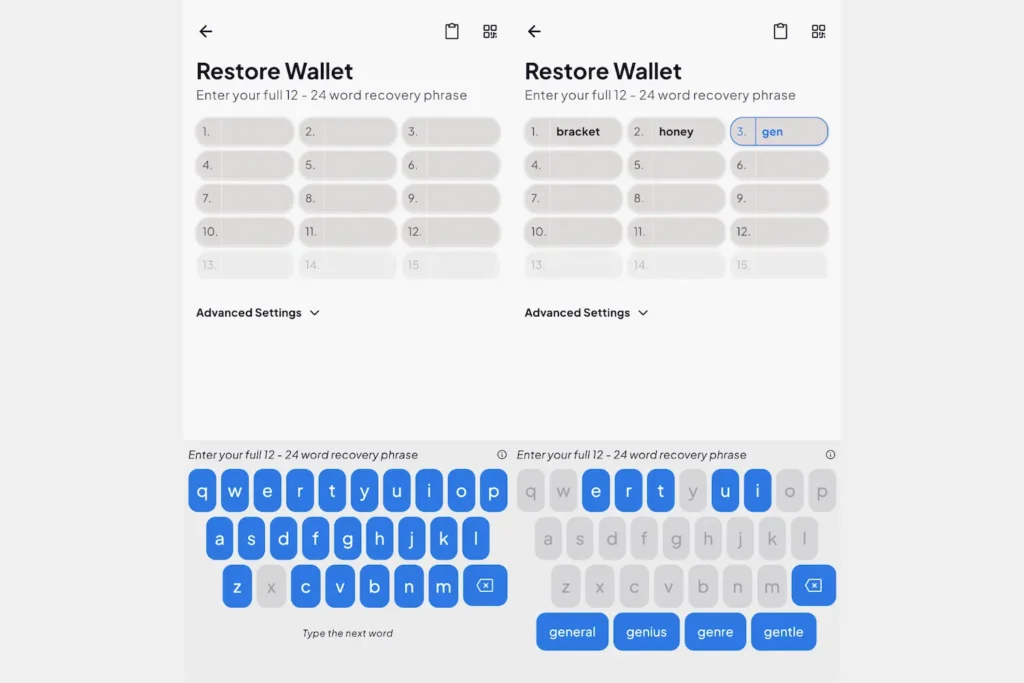
- Enter your recovery words in the correct order using the blue keyboard. This keyboard narrows down word options with each letter typed — a useful feature, since even a single incorrect letter will invalidate the entire phrase.
- After entering your words, press Continue once every word is in place: 12, 18, or 24 words, depending on how your phrase was originally generated.
- The app will prompt you to set up biometric authentication and select which coins to add.
- Once your coins are selected, the wallet should be accessible again.
For most people, this process is enough. Where things become more involved is when the seed phrase itself is not accepted — which is worth investigating carefully before drawing any conclusions.
Having Invalid Coinomi Recovery Phrase?
Coinomi uses the official BIP39 word list — a carefully curated set of words chosen to be distinct, easy to spell, and unlikely to be confused with one another. If your phrase is not being accepted, that almost never means your funds are gone. It typically means something in the phrase needs to be corrected, and it is usually something small.
A few things are worth checking methodically before anything else:
- Word order matters. The phrase must be entered exactly as it was originally generated. If you are unsure of the order, try working through logical variations. Look-alike words such as “game” and “gain” are a frequent source of confusion.
- Typing errors are more common than most people expect. If a single word is not being accepted by the app, check for subtle mistakes — “hammer” entered instead of “hamster,” for example.
- The phrase must be complete: 12, 18, or 24 words, matching the length it had when it was generated. Adding or removing even one word will cause it to fail.
- Language matters too. Coinomi supports mnemonic phrases in multiple languages. If you originally generated your phrase in a language other than English — or later wrote it down translated — you must restore it in that same language.
BIP39 Checksum Validation
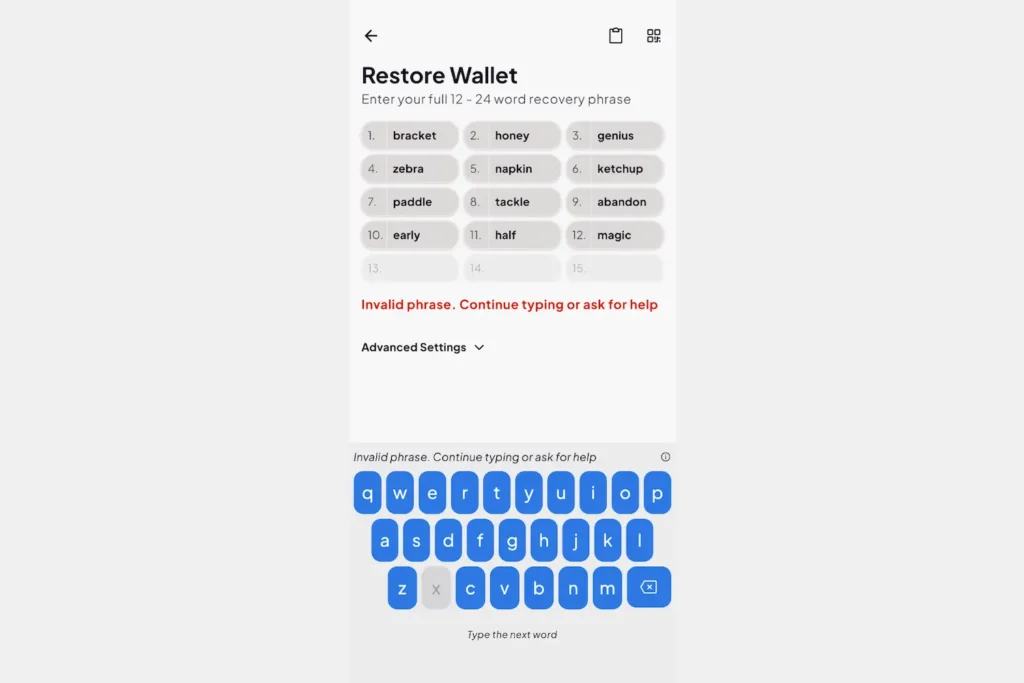
Every BIP39 phrase includes a built-in error check: the final word is derived from a hash of all the preceding words and serves as a checksum. If that last word is wrong, the entire phrase will be rejected — which is why a single incorrect word at the end can block access entirely. If you are comfortable with Python, you can verify your phrase with this snippet, but only on a machine that is permanently offline. Delete the file afterward. Your seed phrase should never touch a device with an internet connection.
from mnemonic import Mnemonic
m = Mnemonic(‘english’)
print(m.check(‘word1 word2 word3 … word24’)) # Returns True or False
Install the library with pip install mnemonic, run it with no internet connection, and it will return True for a structurally valid phrase or False if the checksum fails. It is a useful first step — it tells you whether the issue is with the phrase structure itself or somewhere else entirely. If Python is not familiar territory, skip this step: a wrongly handled seed phrase is a far bigger risk than an unverified checksum.
It is also worth noting that Coinomi cannot assist with an invalid phrase. As a non-custodial service, they do not hold your private data and have no means to retrieve it. If, however, you still have the wallet open on an existing device, the phrase can be revealed by navigating to Settings → Manage Wallets, tapping the three dots beside the default wallet, and selecting “Recovery Phrase.” A face scan or PIN will be required.
Lost Coinomi Recovery Phrase
If the recovery phrase has been lost entirely and the wallet is no longer open on any device, the situation requires honest clarity: access to that wallet cannot be restored without at least a partial phrase to work from. There is no recovery button, and the mathematics involved are not forgiving — four missing words already create around 17.6 trillion possible combinations, and a full 24-word phrase encodes 256 bits of entropy (2^256 possibilities), which is beyond any realistic brute-force approach with current hardware. We, at Crypto Recovers, will always tell you upfront whether a case is realistically workable before any effort goes into it. If the numbers genuinely do not favour recovery, we would rather say so clearly than take on a case we cannot resolve.
The most practical step at this stage is a thorough, unhurried search of every place the phrase might have been stored: old notebooks, physical safes, encrypted notes, cloud backups, or anywhere you may have written it down in the weeks following setup. It is worth taking your time here — these things do turn up.
Coins Are Not Showing Up After Wallet Restoration Issue
A missing balance after restoration is one of the more common situations we see, and it is worth saying clearly: it almost never means the funds are gone. Pre-2018 Coinomi wallets sometimes used non-standard derivation paths for certain coins, which can cause them to appear absent when they are not.
The first thing to check is whether the coins have been added at all. Coinomi requires manual coin selection after each restoration — they are not added automatically. Work through the list using the + button and add each coin or token you previously held.
If the balance is still not showing after that, a couple of further things are worth checking:
- If you are restoring a legacy Coinomi wallet, derivation paths may not update automatically. For coins such as BTC, LTC, and DASH, you may need to either update your Coinomi desktop app or configure the path manually.
- It is also possible you are looking at the wrong wallet. Coinomi supports multiple wallets, so if one shows no balance, it may simply be that a different seed phrase needs to be imported.
Derivation Path Quick Reference
| Coin | Coinomi Path | Trust Wallet Alt | Fix if Zero Balance |
| BTC Legacy | m/44’/0’/0’/0/0 | Same | Enable in Settings > Coins |
| BTC Native SegWit | m/84’/0’/0’/0/0 | m/84’/0’/0’/0/0 | Rescan blockchain |
| ETH / ERC-20 | m/44’/60’/0’/0/0 | Same | Add token contract address |
| Pre-2018 quirk (e.g., DASH) | Custom (check legacy app) | Manual set | Update to v2023+ |
In our experience, a missing balance after restoration is almost never a sign that funds have moved or been lost. Nine times out of ten, it comes down to a path configuration or a missed step during the coin selection process.
Forgot Password to Coinomi Wallet?
The Coinomi app uses AES-256 encryption with the Argon2id algorithm — a combination specifically designed to resist brute-force and GPU-based cracking attempts. In practice, this means a forgotten password cannot be recovered directly. However, the password is local protection only. If you have your seed phrase, you can restore full access to your funds on any new device without it.
If both the password and the seed phrase are unavailable, access to the wallet cannot be restored through any current technical method.
Failed to Restore Coinomi Into Another Wallet?
Coinomi follows the BIP39 seed standard, which means the same phrase can usually be used to access funds through other compatible wallets. That said, compatibility is not always seamless — each wallet has its own approach to derivation paths, and without the correct path configured, the balance will appear as zero even when the funds are present.
| Wallet | Pros | Cons | Best Used For |
| Trust Wallet | Multi-coin, follows BIP39/BIP44, no custom paths needed | Mobile only | Most coins and tokens |
| Electrum | BTC-only, fastest sync, lightweight | Bitcoin only, requires custom paths | Bitcoin recovery |
| Exodus | Multi-coin, no custom path configuration needed, beginner-friendly | Less control over derivation paths | Multi-coin, ease of use |
| MetaMask | Best for ETH and ERC-20 tokens | ETH/ERC-20 only — does not support BNB or other chains | Ethereum tokens only |
One thing worth flagging specifically: MetaMask handles ETH and ERC-20 tokens only. Importing a BNB (BSC) wallet into MetaMask will show a zero balance even if funds are present — the network simply is not supported. For BNB, Binance Chain Wallet or Trust Wallet are the appropriate choices.
If you are unsure which derivation path applies to your coins, or if configuring paths manually feels unclear, that is a reasonable point to seek a second opinion before making further changes.
Token Network Mismatch
A token network mismatch is a common cause of apparent missing balances that has nothing to do with the seed phrase at all. Many tokens — USDT being the clearest example — exist simultaneously across multiple networks: Ethereum, Tron, and BSC, among others. If you add the token on the wrong network in your wallet, the balance will show as zero, even though the funds are sitting intact elsewhere on-chain. Before concluding something has gone wrong, it is worth confirming which network your tokens were originally sent or held on.
Still Cannot Get Your Funds? Reach Out to Professionals
If you have worked through the steps above and access remains out of reach, it may be worth having someone experienced look at the specifics of your case. The situations that remain unresolved after the standard checks are typically those involving a partial seed phrase, an unusual derivation path configuration, or a legacy wallet issue — all of which can be properly assessed once the full picture is understood.
Here’s more information about the recovery process behind the scenes.
CryptoRecovers has been working on cases like these since 2019: incomplete seed phrases, forgotten passwords, and missing balances after restoration. The process starts with an honest assessment of what is recoverable and what a realistic timeframe looks like. Cases can be reviewed in person or remotely, and no recovery steps are taken without a clear explanation of the approach first.