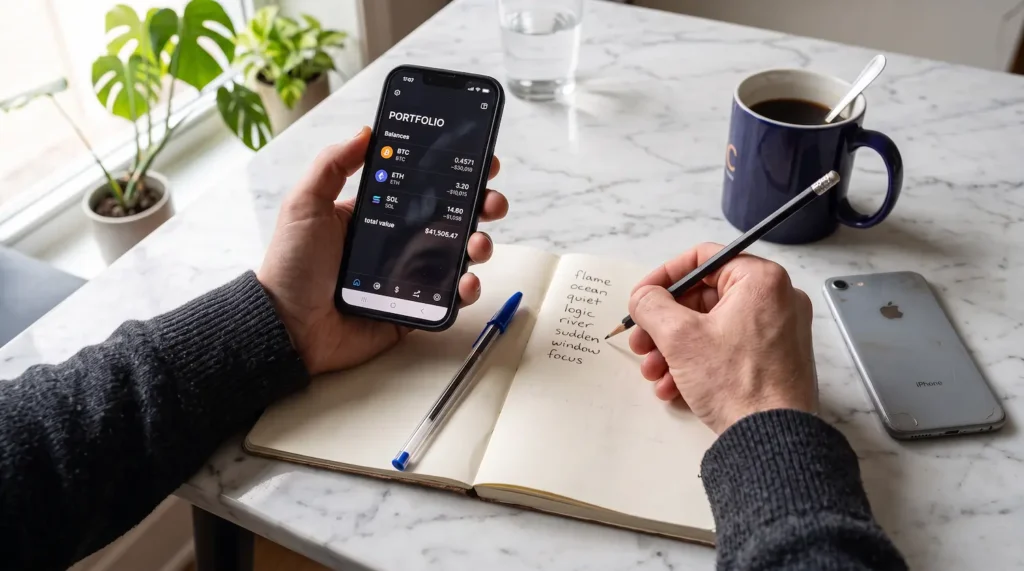

If you are searching for your Bitcoin Core seed phrase, here is the answer upfront: there is none. Bitcoin Core does not generate a seed phrase. It never has. No version of Bitcoin Core, old or new, shows you 12 or 24 English words during wallet setup. There is no “write these words down” screen, and there is no set of words that can restore your Bitcoin Core wallet.
This is the single most important thing to understand about Bitcoin Core recovery, and it is the fact that catches most people off guard. If you have used MetaMask, Electrum, Ledger, Trezor, Trust Wallet, or almost any other modern wallet, you are used to a seed phrase being the master backup. Bitcoin Core does not work that way. Your backup is a file called wallet.dat, and the password you set on that file is the only lock between you and your private keys.
Why Bitcoin Core Has No Seed Phrase
Bitcoin Core was the first Bitcoin wallet, released in 2009. The concept of a mnemonic seed phrase did not exist yet. The BIP-39 standard that defines the 2,048-word list used by most modern wallets was not proposed until 2013, and Bitcoin Core’s developers chose never to adopt it. That decision was deliberate: the Bitcoin Core team considered BIP-39 to be an imperfect standard for several technical reasons, and they never implemented it.
Instead, Bitcoin Core uses its own approach to key management, which has changed over the years but has never included a human-readable word-based backup.
How Bitcoin Core Actually Stores Your Keys
Legacy Wallets (2009 to 2016, and Many Later Ones)
In Bitcoin Core’s original design, every private key is generated independently as a random number. There is no mathematical relationship between the keys. Key number 1 has nothing to do with key number 2. They are separate random values, all stored in the wallet.dat file.
To save time, Bitcoin Core pre-generates a pool of keys (historically 100 by default) so it does not need to create a new one for every transaction. But these pooled keys are still independent random values. If Bitcoin Core generates new keys beyond what was in the pool at the time you made a backup, that backup will be missing the newer keys. This is the central fragility of the legacy design: your backup can go stale without you noticing.
The consequence is stark: if you lose wallet.dat and you never exported individual private keys, the Bitcoin is permanently inaccessible. There is no seed, no phrase, no master key that can regenerate those random values. They existed in one place, and that place was the file.
HD Wallets (Bitcoin Core 0.13 and Later)
Bitcoin Core 0.13, released in August 2016, introduced hierarchical deterministic (HD) key generation based on BIP-32. In an HD wallet, all keys are derived from a single master seed through a deterministic mathematical process. This means that, in principle, the seed alone can regenerate every key the wallet has ever produced.
However, and this is where people get confused, Bitcoin Core’s HD seed is not a seed phrase. It is a raw binary value stored internally in wallet.dat. Bitcoin Core does not convert it into BIP-39 mnemonic words. It does not display it as 12 or 24 English words. It does not prompt you to write anything down. The HD seed exists as a hexadecimal string inside the wallet file, invisible to the user unless you go looking for it with console commands.
Even with HD enabled, Bitcoin Core’s backup model remains file-based. The HD seed lives in wallet.dat, and if wallet.dat is lost, the seed is lost with it, unless you specifically extracted it beforehand using the dumpwallet console command. Almost nobody does this, because the interface never suggests it.
Lost your wallet.dat and have no seed phrase?
If the file may still exist on an old drive, recovery could be possible. Crypto Recovers can assess your situation for free.
Can I Extract the HD Seed and Use It Like a Seed Phrase?
If you can still open your wallet (you know the password), you can extract the HD seed using the dumpwallet command in the Debug Console. This exports all keys to a text file, and the HD seed appears as a line labelled “hdseed=” followed by a hexadecimal string.
But this hex string is not a BIP-39 mnemonic. You cannot type it into MetaMask, Ledger, Electrum, or any other wallet and get the same addresses. The derivation paths are incompatible, and the encoding is different. The HD seed is useful as a backup within Bitcoin Core itself, nothing more. If you want to move your funds to another wallet, the correct approach is to export individual private keys using dumpprivkey and import them, or simply send the Bitcoin to a new address in the destination wallet.
The sethdseed Command
Bitcoin Core 0.17 introduced the sethdseed console command, which lets you set a custom HD seed for the wallet. Some users have interpreted this as a way to create a seed-phrase-style backup, but it is not. The command accepts a raw private key in WIF (Wallet Import Format), not a mnemonic phrase. It replaces the wallet’s current HD seed with the one you provide, and all new keys will be derived from it, but the seed is still stored as binary data inside wallet.dat, not as words.
In practice, sethdseed is a tool for advanced users who want to control their key derivation, not a user-facing backup mechanism. It does not change the fundamental recovery model: wallet.dat plus password is still everything.
What This Means for Recovery
For every Bitcoin Core wallet, legacy or HD, recovery comes back to two things: the wallet.dat file and the password that encrypts it.
If you have the file and forgot the password, that is a solvable problem. Password recovery tools like BTCRecover and Hashcat can test candidates against the encrypted file, and professional services like Crypto Recovers do this on dedicated hardware. For a full walkthrough, see our guide on Bitcoin Core password recovery.
If you lost the file, recovery depends on whether it can be retrieved from the drive it was stored on. Deleted files often survive in unallocated disk space, especially on older spinning hard drives. Our wallet.dat recovery guide covers what is possible and what to do (and not do) with the drive.
If both the file and the password are gone, and no private keys were ever exported, the Bitcoin is permanently inaccessible. No seed phrase exists to fall back on, because Bitcoin Core never created one. This is the reality of Bitcoin Core’s design, and it is the reason that making and safeguarding copies of wallet.dat is not optional. It is the only backup you will ever have.
Have a wallet.dat but cannot remember the password?
The file is what matters, and if you have it, recovery is often possible. Contact us for a free assessment.
FAQ
Does any version of Bitcoin Core support BIP-39 seed phrases?
No. The Bitcoin Core development team has never implemented BIP-39. No version of Bitcoin Core, past or present, generates or accepts a 12-word or 24-word mnemonic phrase. If you have a BIP-39 seed phrase, it came from a different wallet application.
I found 12 words written on a piece of paper. Could they be from Bitcoin Core?
Almost certainly not. If the words match the BIP-39 wordlist, they are from a wallet that uses BIP-39: Electrum, MetaMask, Ledger, Trezor, Trust Wallet, or one of many others. Bitcoin Core never generates word-based backups. Try importing the phrase into Electrum or a BIP-39-compatible wallet to see which addresses it produces.
Can I import a BIP-39 seed phrase into Bitcoin Core?
No. Bitcoin Core does not recognise BIP-39 mnemonics. If you have a seed phrase from another wallet, import it into a wallet that supports BIP-39, such as Electrum (with the appropriate import option), or the wallet application that generated it.
I created my wallet in 2012. Is it legacy or HD?
Legacy. HD wallet support was introduced in Bitcoin Core 0.13 in August 2016. Any wallet created before that version uses independently generated keys with no master seed. Even wallets created after 2016 may be legacy if the user upgraded Bitcoin Core without creating a new wallet.
What happens if I lose wallet.dat and have no seed phrase?
If the file is truly gone, no backup exists anywhere, and no private keys were ever exported, the Bitcoin in that wallet is permanently inaccessible. This is the most consequential limitation of Bitcoin Core’s design. There is no seed phrase to fall back on, no cloud backup, and no way to regenerate the keys from memory. The wallet.dat file was the only copy.
Can Crypto Recovers help without a seed phrase?
If the wallet.dat file still exists, yes. The file contains everything needed, and the password is the only barrier. We do not need a seed phrase, because Bitcoin Core never created one. What we need is the file (or a drive it may be on) and whatever you remember about the password. If the file is gone and no backup exists, there is nothing for us or anyone else to work with, and we will tell you that honestly during the free assessment.