
Every account in MetaMask is controlled by a private key: a 64-character hexadecimal string that proves ownership of one specific Ethereum address. If you have the private key, you can sign transactions, move tokens, and interact with smart contracts from that address. If someone else gets the private key, they can do the same thing. No confirmation, no recovery, no reversal.
This article explains what a MetaMask private key is, how to export it, how to import one into a new installation, and how to store it so it stays safe without becoming inaccessible.
What a Private Key Controls
A private key gives full control over one Ethereum address. That means all ETH, all ERC-20 tokens, all NFTs, and all smart contract interactions associated with that address. It does not give access to any other account in the same MetaMask wallet. If your wallet has three accounts, each has its own private key, and exporting one does not expose the others.
The private key is mathematically linked to the public address. Anyone can see the public address and its balance on the blockchain. Only the holder of the private key can authorise transactions from it. This is the foundation of non-custodial crypto: ownership is proof of possession of the key, nothing else.
Private Key vs Secret Recovery Phrase
The Secret Recovery Phrase is the master key. It generates every private key in the wallet through a deterministic process defined by the BIP-39 and BIP-44 standards. If you have the phrase, you can regenerate every private key. If you have only a private key, you can access only the one account it belongs to, and you cannot derive the phrase or any other key from it.
Think of it this way: the phrase is the root of a tree, and each private key is a branch. You can regrow any branch from the root, but you cannot reconstruct the root from a branch. This is why backing up the phrase is more important than backing up individual keys, but also why exporting a private key for a specific high-value account can serve as a useful secondary backup.
How to Export Your Private Key from MetaMask
You can export the private key for any account that MetaMask has access to. The steps differ slightly between the browser extension and the mobile app.
Browser Extension
Open MetaMask, click the three-dot menu next to the account name, and select “Account details.” Click “Show private key” (on older versions this may say “Export private key”). MetaMask will ask you to enter your password. After confirmation, the private key appears as a 64-character hexadecimal string. Copy it and store it in a secure, offline location immediately. Do not leave it on your clipboard, and do not save it in a text file on your computer.
Mobile App
Open the MetaMask app, tap the account selector at the top, choose the account you want to export, then go to Settings, Security & Privacy, and select “Show private key.” Enter your password or use biometric authentication. The key is displayed on screen. Write it down by hand rather than taking a screenshot.
Lost your private key and your Secret Recovery Phrase?
If the encrypted vault still exists on your device, recovery may be possible through our MetaMask recovery service.
How to Import a Private Key into MetaMask
If you have a private key from a previous MetaMask installation, from another wallet application, or from an exported backup, you can import it into any MetaMask installation.
Open MetaMask, click the account selector (the circle icon at the top), and choose “Import Account.” Select “Private Key” as the import type, paste the 64-character hexadecimal string, and click “Import.” The account and its full balance will appear in MetaMask immediately.
An important detail: an imported account is not derived from your current Secret Recovery Phrase. That means if you later restore your wallet using the phrase, the imported account will not appear automatically. You would need to re-import it using the private key. This is why keeping a backup of the key is essential for any imported account.
When to Export a Private Key
There are a few legitimate reasons to export a private key. You may want a backup of a specific high-value account as a secondary safety net alongside your Secret Recovery Phrase. You may need to import an account into a different wallet application, such as Trust Wallet or a DeFi interface, that requires the private key. Or you may be migrating an account from one MetaMask installation to another without using the phrase.
Do not export your private key in response to any request from a website, email, support agent, or DM. No legitimate service will ever ask for it. A request for your private key is, without exception, a scam.
How to Store a Private Key Safely
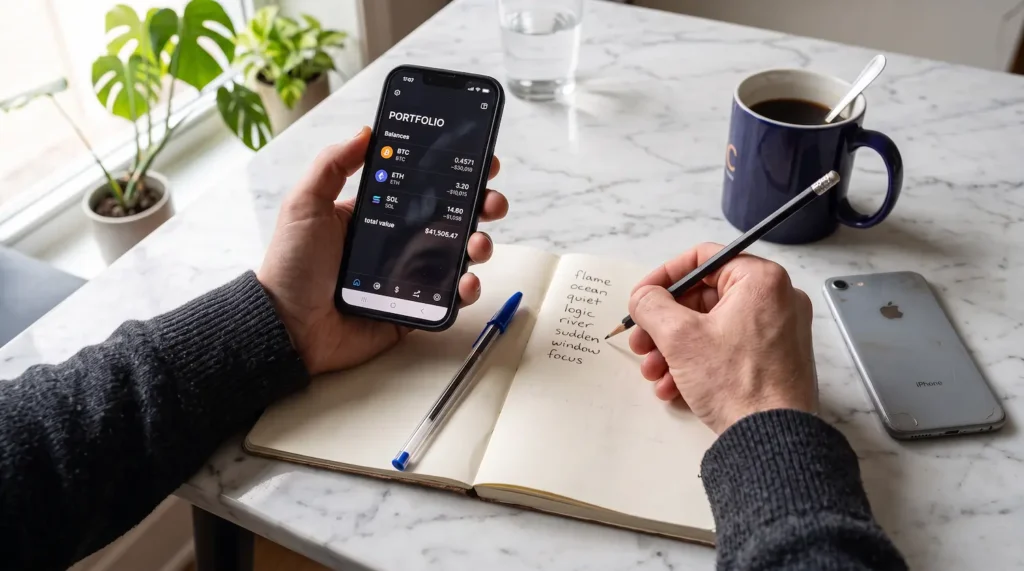
The same rules that apply to the Secret Recovery Phrase apply to private keys: keep them offline, keep them physical, and keep them in a secure location. Write the key on paper and store it in a safe. For higher durability, consider a metal backup plate.
Do not store private keys in a password manager connected to the internet, in a cloud-synced notes app, in an email draft, or anywhere else that is digitally accessible. If your computer is compromised, any file or application on it can be read. A private key stored in a text file on your desktop is effectively public.
If you manage multiple accounts, label each key clearly so you know which address it belongs to. A private key without context is just a meaningless string, and testing random keys against the blockchain to find the matching address is not practical.
What Happens If Someone Gets Your Private Key
If anyone else obtains your private key, they can drain every asset from the associated address. They do not need your password, your MetaMask installation, or your permission. The key alone is sufficient. Blockchain transactions are irreversible: once the assets are moved, they cannot be recovered.
If you suspect a private key has been compromised, transfer all assets from that address to a new address immediately. Do not wait. Automated bots monitor leaked keys and can drain wallets within seconds of the key appearing anywhere online. For a full guide on responding to a compromised wallet, see our article on what to do when MetaMask is hacked.
Need help recovering a MetaMask account?
If you have lost both your private key and Secret Recovery Phrase but still have the device, recovery may be possible. Read our full guide on recovering a MetaMask wallet for more details.
FAQ
Where does MetaMask store the private key?
MetaMask stores private keys in an encrypted vault file within the browser’s extension data directory. The vault is encrypted with your MetaMask password. The keys are only decrypted in memory when you unlock the wallet and sign a transaction.
Can I recover my private key if I lost it?
If you have your Secret Recovery Phrase, you do not need to recover the key: MetaMask regenerates it automatically when you restore the wallet. If you have neither the key nor the phrase, the key can only be recovered by extracting and decrypting the vault file from the original device, which requires the password or a password recovery process.
Can I use the same private key in multiple wallets?
Yes. The same private key can be imported into MetaMask, Trust Wallet, MyEtherWallet, or any Ethereum-compatible wallet. The balance will be the same in each, because the blockchain is the single source of truth. Keep in mind that using the key in multiple places increases the risk of exposure.
Is it safe to export my private key?
It is safe as long as you store it properly. The act of exporting is not the risk. The risk is what happens afterward: where you save it, who can access it, and whether it ends up in a digital location that can be compromised. Export it, write it down, and store the paper copy securely. Then clear your clipboard.